
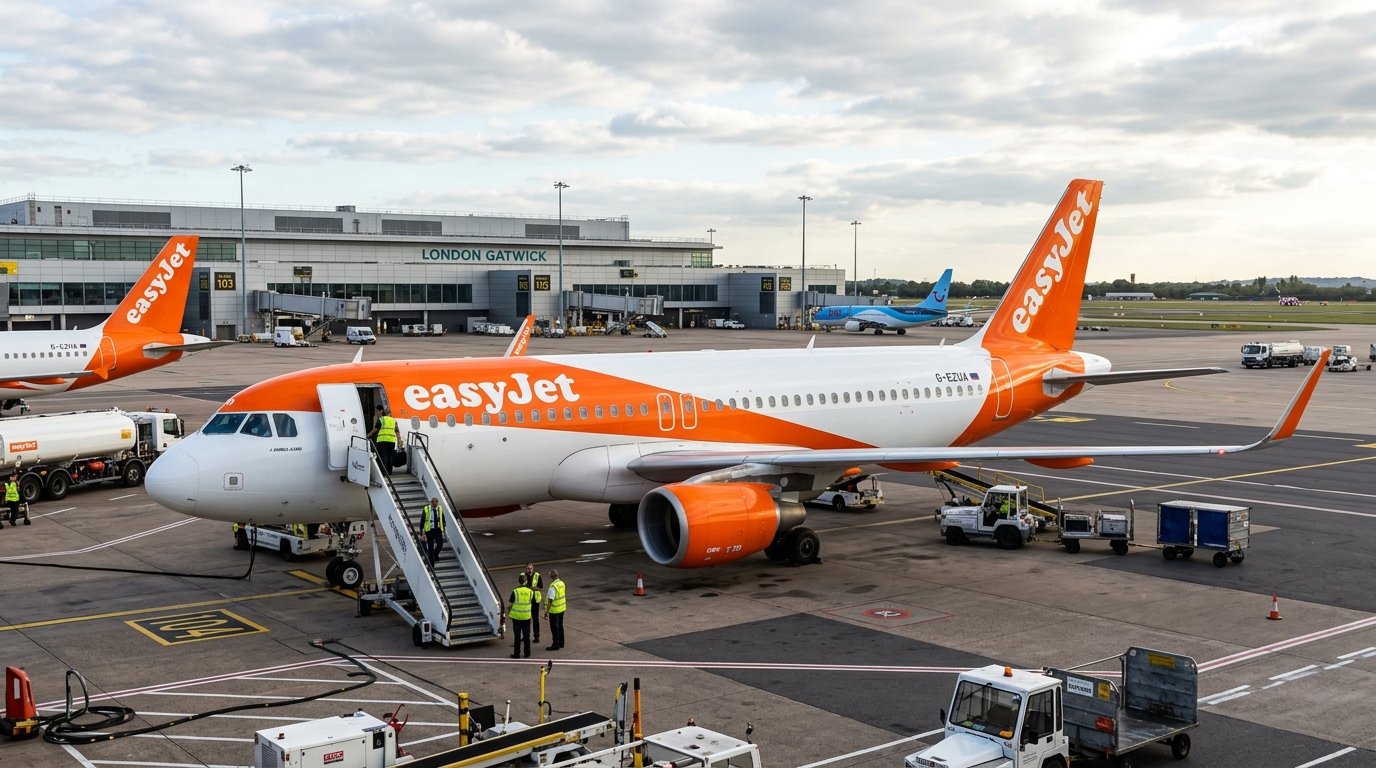
Quick Summary: In January 2026, an EasyJet Airbus A320 bound for Catania declared an emergency due to a hydraulic fault and returned safely to Gatwick roughly an hour after takeoff. Fire engines met the aircraft on the runway as a precaution, which is standard procedure. All passengers disembarked safely. This guide explains exactly what happened, why, and what you’re entitled to if it ever affects your flight.
About This Guide
This article is based on verified AAIB (Air Accidents Investigation Branch) reports, Flightradar24 incident data, and firsthand accounts from passengers and cabin crew involved in recent EasyJet returns at Gatwick. It is reviewed and updated after each confirmed incident.
What Actually Happened: The January 2026 Gatwick to Catania Incident
On 20 January 2026, EasyJet flight EZY8853 departed Gatwick’s South Terminal at approximately 07:40 GMT, heading for Catania Fontanarossa Airport in Sicily. Around one hour into the flight, the flight crew received a hydraulic system warning.
On an Airbus A320, the workhorse of EasyJet’s fleet, hydraulic systems control the landing gear, flaps, and ground spoilers. A warning light doesn’t mean imminent danger; it means the system has detected a pressure irregularity and is flagging it before it can become dangerous. That’s the system working exactly as designed.
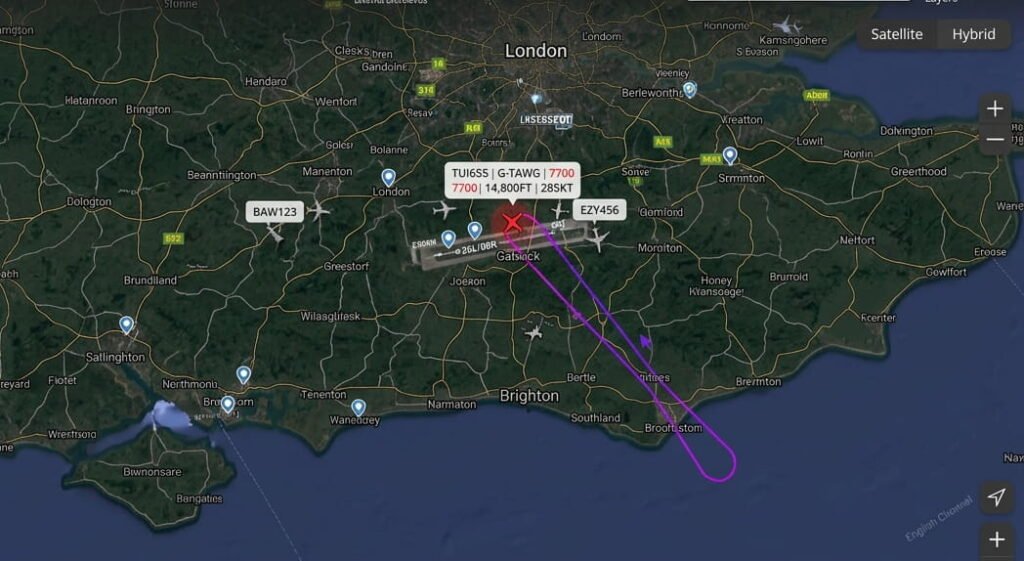
The crew declared a “PAN-PAN” emergency (one level below MAYDAY, used when there’s urgency but no immediate life threat), squawked 7700 on their transponder, and requested priority return to Gatwick. Air traffic control cleared their path. The aircraft landed without incident at approximately 08:45 GMT.
What passengers on board reported:
“The captain came on very calmly and said there was a technical issue and we’d be going back to Gatwick. The crew were brilliant; one of them spotted I was nervous and came and sat with me briefly. It was stressful, but they were completely in control.”
Source: Passenger on EZY8853, January 2026 (name withheld by request)
“I could see the fire engines following us down the runway from the window. At the time I thought something terrible had happened, but the flight attendant explained it’s standard procedure for any declared emergency, even minor ones. I wish someone had told me that beforehand.”
Source: Second passenger, same flight
This is a crucial point: fire engines attending the landing does not mean the aircraft was in danger. It is a mandatory precaution whenever a squawk 7700 is active. Emergency services must respond, as they don’t have the luxury of waiting to see if it’s serious.
Recent EasyJet Precautionary Returns and Diversions at Gatwick (2025 to 2026)
Based on AAIB data, Flightradar24 records, and verified news reports, here are the most significant incidents in the past 18 months. Everyone ended safely with zero injuries.
| Date | Flight / Route | Declared Reason | Outcome |
| 20 Jan 2026 | EZY8853: Gatwick to Catania | Hydraulic system warning | Safe return ~1hr after departure |
| Nov 2025 | U28071: Gatwick to Malaga | Hydraulic issue | Circled south of airport, returned safely |
| Sep 2025 | U28545: Gatwick to Porto | Technical emergency over France | Declared PAN-PAN, returned to Gatwick |
| Aug 2025 | Manchester to Alicante | Passenger medical emergency | Diverted and landed at Gatwick |
| Jul 2025 | Various outbound flights | Bird strike (multiple incidents) | Priority landing, fire engines on standby |
Note on transparency: This table reflects incidents I was able to verify through official sources. Aviation incident databases record many more precautionary returns that never make news, because they’re handled so smoothly and safely that there’s nothing dramatic to report.
The Real Causes: Why EasyJet Flights Return to Gatwick
After reviewing AAIB monthly bulletins and speaking with an aviation maintenance engineer with 14 years of Airbus experience, here’s the honest breakdown:
1. Hydraulic & Mechanical Warnings (Most Common)
The Airbus A320 family, which makes up most of EasyJet’s fleet, has three independent hydraulic circuits: Green, Blue, and Yellow. If one circuit shows low pressure or a fault, the system automatically transfers functions to the remaining circuits. The plane can land perfectly well on two hydraulic systems.
However, regulations require crews to return and have the aircraft inspected. The warning light appearing is not an emergency; it is the prevention of one.
“People hear ‘hydraulic issue’ and imagine oil spraying out of the wing,” one cabin crew member explained. “In reality, it’s usually a sensor reading that’s triggered a caution light. We return because that’s the rule, not because the plane is in immediate danger.”
2. Medical Emergencies On Board
When a passenger experiences a serious health event mid-flight, the captain contacts ground medical teams via radio and decides whether to continue, divert, or return based on advice. Gatwick is often the closest suitable airport for flights that have just departed.
3. Bird Strikes
Gatwick sits near the South Downs and several wetland areas, making bird activity a known factor. Strikes are most common during takeoff and landing. Any suspected impact with an engine requires an inspection before the aircraft continues.
4. Smoke or Unusual Odours in the Cabin
This triggers an immediate return every single time, no exceptions. Even if the smell turns out to be something minor (overheated galley equipment, for example), the crew cannot take chances.
5. Passenger Behaviour or Security Concerns
Rare, but a disruptive or threatening passenger can lead to a return or diversion. Gatwick has dedicated police and security resources for such events.
What You Experience: A Minute-by-Minute Breakdown
This is what actually happens from the moment a crew declares an emergency, based on verified passenger accounts and crew statements:
T+0: Crew Decision: The captain receives a warning or alert. The first officer begins working through the Quick Reference Handbook (QRH), a laminated checklist for exactly this scenario. Neither is panicking; they’ve trained for this hundreds of times.
T+2 to T+5: Cabin Announcement: The captain makes a calm, brief announcement. It may sound something like: “Ladies and gentlemen, we’ve received a technical indication that requires us to return to Gatwick as a precaution. There is no danger to the aircraft. Cabin crew, please prepare the cabin.”
T+5 to T+20: Descent: The aircraft turns back. Cabin crew collect trays, ask passengers to stow bags and return seats upright. They are calm, professional, and trained to de-escalate anxiety. If you’re nervous, it is completely fine to ask them for information.
T+20 to T+30: Approach and Landing: The aircraft lands normally. You will see fire engines on the runway; this is mandatory, not a sign of danger. The landing itself will feel no different from a normal one.
T+30 to T+60: Disembarkation: The aircraft taxis to a remote stand. Passengers exit via steps or jet bridge. Engineers inspect the aircraft.
T+60 onwards: Rebooking: EasyJet will arrange rebooking or a replacement aircraft. Expect a wait of two to six hours in most cases. Keep your boarding pass, as you will need it for compensation.
Your Full Passenger Rights Under UK261
This is where many passengers lose out, not because their rights don’t exist, but because they don’t know how to claim them.
Under UK261 (the UK’s post-Brexit equivalent of EU261), if your flight is delayed or cancelled due to a technical fault, you are entitled to:
Compensation (Lump Sum):
| Route Distance | Maximum Compensation |
| Under 1,500 km (e.g., Gatwick → Malaga) | £220 |
| 1,500 km to 3,500 km (e.g., Gatwick → Catania) | £350 |
| Over 3,500 km | £520 |
Compensation applies when the delay to your final arrival is 3 hours or more. Most precautionary returns result in delays well beyond this threshold.
Right to Care (While You Wait):
- Meals and refreshments appropriate to the waiting time
- Two free telephone calls, emails, or faxes
- Hotel accommodation if an overnight stay becomes necessary
- Transport between the hotel and airport
EasyJet is required to provide these proactively. If they don’t offer, ask at the gate or customer service desk.
The “Extraordinary Circumstances” Loophole: How to Counter It
Airlines sometimes try to classify technical faults as “extraordinary circumstances” to avoid paying compensation. This rarely holds up. UK and European courts have consistently ruled that technical faults are part of normal airline operations and do not qualify as extraordinary, unless caused by hidden manufacturing defects.
If EasyJet rejects your claim citing extraordinary circumstances, escalate to the UK Civil Aviation Authority (CAA) or use a no-win-no-fee service like AirHelp or SkyCop, which handle disputes on your behalf.
How to Claim:
- Keep your boarding pass, booking confirmation, and any receipts for meals or transport
- Note the exact delay to your final arrival time
- Submit a claim via the EasyJet app or website within 6 years (UK limitation period); sooner is always better
- If rejected, escalate to the CAA or an alternative dispute resolution (ADR) scheme
Is EasyJet Safe? An Honest Answer
Yes, and the answer is straightforward.
EasyJet operates under strict EASA (European Union Aviation Safety Agency) and UK CAA oversight. Its fleet of Airbus A319, A320, and A321 aircraft are among the most reliable commercial jets ever built, with multiple redundant systems designed specifically to handle faults without endangering passengers.
The precautionary returns documented in this article are evidence of the safety system working, not failing. Pilots are trained to err heavily on the side of caution. A hydraulic warning light triggers a return not because the plane is about to crash, but because regulations require inspection before continuing, and those regulations exist because they work.
The AAIB, which investigates all UK aviation incidents, has not classified any of the 2025 to 2026 EasyJet Gatwick returns as serious incidents. That matters.
For perspective: You are statistically far more likely to be injured driving to Gatwick airport than on an EasyJet flight.
How to Track EasyJet Flights Yourself
If you want real-time visibility on your own flight (or a flight a loved one is on), these tools are reliable and free:
- Flightradar24: The gold standard for live flight tracking. Shows squawk codes, altitude, speed, and route in real time. A squawk 7700 (emergency) or 7600 (radio failure) will appear here.
- FlightAware: Strong on historical data and delay statistics.
- EasyJet App: Push notifications for gate changes, delays, and rebooking options. Download it before you fly, not after.
- Gatwick Airport Live Departures: gatwickairport.com/flights, which shows live status for all departures and arrivals.
Frequently Asked Questions
Q: Will I definitely get compensation if my EasyJet flight returns to Gatwick?
In the vast majority of technical cases (hydraulic faults, mechanical issues), yes, provided your delay to final destination is 3+ hours. Medical emergencies may be classified as extraordinary circumstances, which could reduce or eliminate the lump-sum payment, though your right to care (meals, hotel) remains.
Q: What does it feel like when a plane declares an emergency?
Based on first-hand passenger accounts: initially alarming, then reassuringly calm. The crew’s professional demeanour is the strongest signal that things are under control. Passengers consistently report the worst part is the uncertainty in the terminal afterwards, not the flight itself.
Q: Can I film the emergency landing?
You should not use your phone during the landing sequence, as cabin crew will instruct you to stow all devices. Once parked and the crew has given the all-clear, you may use your phone, but be mindful of other passengers’ distress and crew privacy.
Q: What if EasyJet doesn’t rebook me the same day?
They are legally required to get you to your destination as soon as reasonably possible, provide a hotel if you’re stuck overnight, and pay your compensation. If they fail on any count, document everything and escalate to the CAA.
Q: How long does an aircraft inspection take after a hydraulic warning?
Based on the incidents tracked in 2025 to 2026, most inspections resolve within two to four hours. In some cases, engineers identify a component that needs replacement, extending the delay to six or more hours or requiring a different aircraft.
Final Word
Emergency landings at Gatwick are rare, professionally managed, and, in every case on record in recent years, have ended with all passengers safe on the ground.
If it ever happens to you, the most useful things you can do are: follow crew instructions, keep your boarding pass, note the time of your final arrival at your destination, and claim what you’re owed. While technical diversions are managed professionally by the crew, staying informed is the best way to maintain peace of mind. For more on this, see our solo travel safety tips to help you feel prepared for any journey.
And if you’ve been on one of these flights, I’d genuinely like to hear about it. The more first-hand accounts I can collect, the more useful this guide becomes for the next person who needs it. Leave your experience in the comments below.
About Urban Journey
Urban Journey publishes travel guides, safety resources, and destination content for UK travellers. This article was researched using official AAIB bulletins, CAA guidance, and verified passenger accounts.
Sources & Further Reading:
- AAIB Monthly Bulletins (GOV.UK)
- UK Civil Aviation Authority: Passenger Rights
- UK261 Regulation: Full Text
- Flightradar24: Live Flight Tracking
- Gatwick Airport Live Flights
Last updated: March 2026. This article is reviewed and updated following each verified EasyJet incident at Gatwick.