
Last Updated: March 30, 2026
Sources: NTSB | FAA | CBC | CNN | CBS News
| ARTICLE HIGHLIGHTS | |
| Flight: Air Canada Express 8646 (Jazz Aviation, CRJ-900) | Cause (preliminary): Runway incursion, fire truck cleared onto active runway during landing |
| Date & Time: March 22, 2026 – 11:37 p.m. EDT | Key failure: Fire truck had no transponder; ground radar did not alert |
| Route: Montréal (YUL) → LaGuardia Airport (LGA) | Investigation: NTSB lead (Case DCA26MA161); Canada TSB assisting |
| On board: 72 passengers + 4 crew | Preliminary NTSB report: Expected late April 2026 |
| Fatalities: Pilots Mackenzie Gunther & Antoine Forest | LaGuardia fully reopened: March 26, 2026 |
| Injured: 41 hospitalized (passengers, crew, firefighters) | Last updated: March 30, 2026 |
Introduction
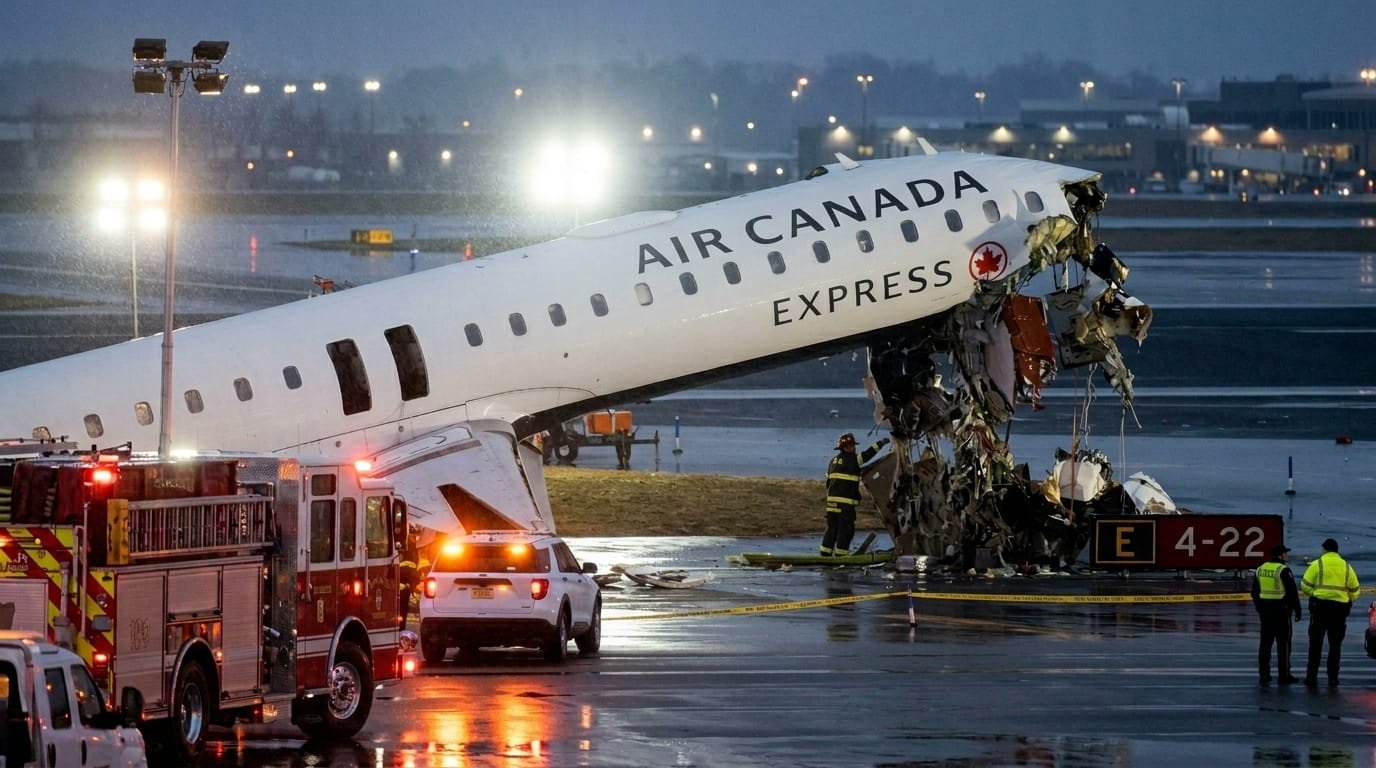
In the final seconds of a routine overnight approach into LaGuardia Airport, two pilots braked as hard as they could. Their aircraft, Air Canada Express Flight 8646, had been cleared to land on Runway 4. A Port Authority fire truck had also been cleared to cross that same runway, with fewer than 25 seconds between the two clearances. The collision destroyed the cockpit. Both pilots were killed. But their final evasive actions almost certainly prevented far greater loss of life among the 72 passengers on board.
This guide presents a fully verified account of the March 22, 2026 runway incursion: the timeline, the preliminary NTSB findings, and what it means for travelers. All facts have been cross-referenced against official NTSB briefings and reporting from CBC, CNN, and CBS News. Where the investigation is ongoing, this is clearly noted.
What Happened: A Minute-by-Minute Timeline
The sequence below is reconstructed from the cockpit voice recorder, air traffic control audio, and flight tracking data, as released or confirmed by the NTSB.
| TIME (EDT) | VERIFIED EVENT |
| 10:12 p.m. | Flight 8646 departs Montréal, delayed approximately two hours |
| ~11:18 p.m. | United Flight 2384 aborts takeoff twice; fumes reported; emergency declared at LGA |
| ~11:20 p.m. | Port Authority fire truck (Truck 1) dispatched to assist the United flight |
| 11:35 p.m. | Flight 8646 cleared to land on Runway 4 – 2 min 17 sec before collision |
| T–25 sec | Truck 1 requests clearance to cross Runway 4 at Taxiway Delta |
| T–20 sec | Tower clears Truck 1 to cross the active runway |
| T–9 sec | Tower issues first urgent stop order to Truck 1: “Stop. Stop. Stop.” |
| T–4 sec | Tower repeats stop order – truck does not stop in time |
| 11:38 p.m. | COLLISION: Nose of CRJ-900 strikes Truck 1 at approximately 81–91 knots |
| T+9 sec | Cockpit voice recorder stops recording |
| T+18 min | Controller says: “We were dealing with an emergency. I messed up.” |
| March 23, ~2 p.m. | LaGuardia partially reopens on one runway |
| March 26, ~10 a.m. | Runway 4/22 reopens; NTSB debris investigation complete |
The aircraft’s ground speed at the moment of impact was approximately 81–91 knots (roughly 93–105 mph). The nose of the CRJ-900 was sheared off. Flight attendant Solange Tremblay was found outside the aircraft, still strapped to her seat, having been ejected approximately 100 metres from the plane. She survived with multiple fractures including a broken leg requiring surgery.
ATC audio later released to the public captured the controller saying “Stop. Stop. Stop. Stop, Truck 1. Stop.” About 18 minutes after the collision, the same controller said: “We were dealing with an emergency earlier. I messed up.” A Frontier Airlines pilot observing from the taxiway responded: “Nah man, you did the best you could.”
Preliminary Causes: NTSB Findings to Date
As of March 30, 2026, the investigation is ongoing. No final cause has been determined. A preliminary NTSB report is expected in late April 2026; the full report may take 12–18 months. NTSB Chair Jennifer Homendy has stated: “The NTSB deals in facts. We don’t speculate.”
Simultaneous Runway Clearances
The NTSB confirmed that ATC cleared Truck 1 to cross Runway 4 approximately 20 seconds before impact – while Flight 8646 was already on short final approach and had been cleared to land over two minutes earlier. The NTSB has identified this as the central runway incursion event.
Fire Truck Had No Transponder
Truck 1 was not equipped with a transponder – technology that allows controllers to precisely identify and track vehicles on the airfield. NTSB Chair Homendy confirmed: “There are transponders on trucks at other airports across the nation. In this case, they did not have transponders.” Without one, controllers were relying on less precise radar returns.
Ground Radar (ASDE-X) Did Not Generate an Alert
LaGuardia is equipped with Airport Surface Detection Equipment, Model X (ASDE-X), which is designed to warn controllers of potential runway conflicts. It did not alert in this instance. The NTSB found that multiple fire vehicles clustered near the runway prevented the system from generating a reliable, high-confidence track, a technical limitation that investigators are examining closely.
Controller Workload on the Midnight Shift
Two controllers were working in the tower at the time, combining multiple roles, ground control and local control – as standard practice for the midnight shift at LaGuardia. The NTSB has noted this staffing configuration as part of its investigation into workload factors. Investigators also found conflicting information in the control tower logs that is still being verified.
Radio Transmission Interrupted Before the Collision
The NTSB confirmed that Truck 1’s initial radio call to the tower, made more than a minute before the collision – was “stepped on” by a simultaneous transmission and was not clearly audible in the control tower. This is a known challenge in high-traffic ATC environments.
The Human Impact
The Pilots
Captain Mackenzie Gunther and First Officer Antoine Forest, 30, of Coteau-du-Lac, Quebec, were killed when the cockpit was destroyed on impact. Seneca Polytechnic flew its flags at half-mast in memory of one of the pilots who graduated there. Antoine Forest’s great-aunt told the Toronto Star: “He was always taking courses and flying. He never stopped.”
Passenger Rebecca Liquori described what she felt in the final seconds: “I’m just so appreciative that they were able to save us, but I’m just so sad that they weren’t able to make it home to their families. I wouldn’t be here had it not been for the pilot acting quickly.”
Passengers and Crew
Forty-one people – including passengers, crew, and both occupants of Truck 1 – were hospitalised. Nine remained in medical care the following day. The final braking and evasive actions taken by the crew in the closing seconds are credited by survivors and aviation observers with preventing a far higher casualty count.
Airport and Travel Disruption
LaGuardia closed immediately after the collision. Flights were diverted to JFK and Newark Liberty International. Early on March 23, a separate ground stop was imposed at Newark due to smoke in the ATC tower, compounding delays across the New York metro area. LaGuardia partially reopened on March 23, with Runway 4/22 fully accessible again by March 26 after the NTSB cleared the debris field.
LaGuardia’s Safety Record in Context
The March 2026 collision did not occur in isolation. Pilots had filed NASA Aviation Safety Reporting System (ASRS) reports in the months prior, raising concerns about runway operations at LaGuardia. In October 2025, a separate taxiway incident involving a Delta flight had also drawn scrutiny. NTSB Chair Homendy referenced these prior concerns, saying: “This is 2026. Controllers should have all the information and tools to do their job.”
Runway incursions involving ground vehicles are rare in U.S. aviation. The March 2026 collision was the product of multiple concurrent system failures – not a routine operational hazard. U.S. commercial aviation remains statistically the safest form of transportation. The NTSB’s investigation is designed to ensure the lessons learned here improve the safety of every airport.
Key Lessons for Air Travelers
Runway Incursions Are Caught Almost Every Time
The FAA tracks runway incursions carefully. The vast majority are detected and resolved by the layered safety systems, radar, radio, visual checks, and pilot alerts – before any collision occurs. March 22, 2026 was a rare exception in which multiple systems failed simultaneously. The NTSB investigation exists precisely to prevent recurrence.
Crew Resource Management Saves Lives
The cockpit voice recorder confirmed a routine approach sequence right up until the final seconds. The captain’s emergency braking, while unable to prevent the collision – absorbed much of the impact energy and is credited with protecting the passenger cabin. This is why crew training standards are so rigorous.
Technology Gaps Are Being Addressed
This incident has already focused international attention on vehicle transponders at airports. The NTSB’s forthcoming recommendations are expected to address transponder mandates and ASDE-X system sensitivity, improvements that will benefit airports across the country.
Flying Remains the Safest Way to Travel
The same aviation safety culture that produced this tragedy will investigate it exhaustively and implement changes. That process – NTSB investigation, FAA action, industry adoption, is exactly how aviation has become the safest form of mass transportation in history. The deaths of the two pilots and the injuries to those on board are a tragic exception to an overwhelmingly safe system.
Practical Tips for Flying into LaGuardia or Any Busy Airport
Check Your Flight Status Before Leaving
- FlightAware (flightaware.com) and Flightradar24 provide real-time gate and delay tracking
- The FAA’s Command Center (fly.faa.gov) shows current ground delay programs
- Enable push notifications on your airline’s app for instant gate changes
Know Your NYC Airport Alternatives
| FEATURE | LaGuardia (LGA) | JFK International | Newark (EWR) |
| Distance to Midtown | ~8 miles (30–45 min) | ~16 miles (45–60 min) | ~16 miles (45–60 min) |
| Transit Access | Bus only (M60, Q70) | AirTrain + Subway/LIRR | AirTrain + NJ Transit |
| Taxi/Uber to Midtown | $35–$55 | $70–$90 | $65–$85 |
| Terminal Status | Newly renovated (2022) | Ongoing renovation | Major renovation underway |
| Best for… | Domestic short-haul | International, long-haul | New Jersey & domestic |
What to Do During a Go-Around or Runway Hold
- Stay calm, go-arounds are a routine, practiced safety procedure, not an emergency
- Follow crew instructions immediately and keep your seatbelt fastened
- Avoid anything that could distract you from crew announcements
Get Travel Insurance with Disruption Coverage
The Flight 8646 collision cascaded into days of delays across New York’s three major airports. Travellers without trip interruption coverage faced expensive last-minute hotel and rebooking costs. Coverage typically costs $30–$80 per trip and is especially worthwhile for connections through major hub airports.
What’s Next: The Investigation Outlook
- Preliminary NTSB Report: Expected late April 2026, will confirm the factual sequence with investigative detail
- Full NTSB Report & Probable Cause: 12–18 months, systemic analysis and binding safety recommendations
- Canadian TSB: Three investigators deployed; TSB Chair Yoan Marier has described the investigation as “especially complex”
- Expected recommendations: Vehicle transponder mandates, ASDE-X sensitivity review, midnight-shift staffing evaluation
Every major NTSB investigation in modern aviation history has produced recommendations that made the global system safer. This investigation will be no different.
Conclusion
The March 22, 2026 collision at LaGuardia was a multi-factor failure: no transponder on the fire truck, a ground radar system that did not alert, and two clearances issued for the same runway within 20 seconds. Two pilots lost their lives. Their final actions in the cockpit prevented far greater loss.
The NTSB investigation is ongoing. As findings are released, this post will be updated. Flying remains, by every measurable standard, the safest way to travel, and the investigation will make it safer still.
Sources & References
- NTSB – Official Investigation Page: ntsb.gov/investigations/DCA26MA161
- CBC News – “What We Know and Don’t Know About the Deadly Air Canada Plane Crash” (March 24, 2026)
- CNN – “Fire Truck in LaGuardia Runway Collision Had No Transponder” (March 24, 2026)
- CNN – “What’s Next in the Investigation Into the Deadly Air Canada Collision at LaGuardia” (March 25, 2026)
- CBS New York – “NTSB Describes LaGuardia Airport Runway Crash Cockpit Audio” (March 26, 2026)
- NBC News – “Flights Resume After 2 Dead, Dozens Injured in Air Canada Crash at LaGuardia”
- Wikipedia – “Air Canada Express Flight 8646” (Updated March 30, 2026) used for chronological reference only