

Introduction
Flight delays are frustrating and disruptive, but knowing your rights can turn a bad situation into a compensated one. This comprehensive guide covers passenger rights across major regions including the EU, UK, US, Canada, and more. Whether you’re dealing with a short domestic delay or a long-haul international disruption, learn what compensation, refunds, meals, hotels, and rebooking options you’re entitled to.
Why Flights Get Delayed – Common Causes
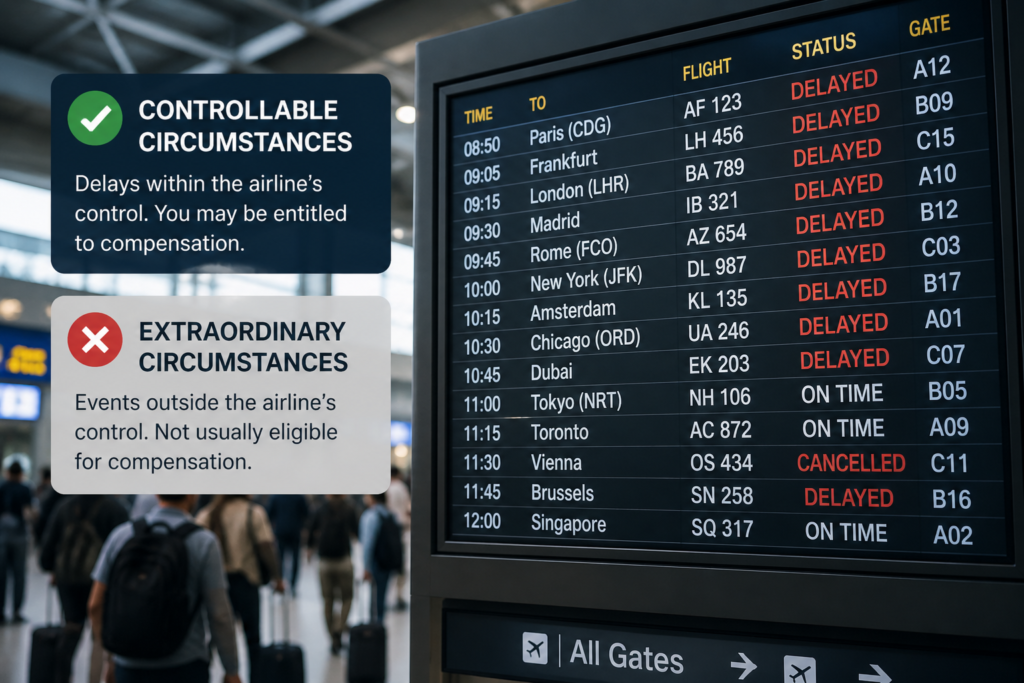
Understanding the reasons behind delays is crucial because it directly impacts your eligibility for compensation or assistance. Airlines and regulators generally divide causes into two main categories:
- Airline-controllable: These include mechanical issues, crew scheduling problems, operational inefficiencies, baggage loading delays, or cabin cleaning. In most jurisdictions, these make you eligible for compensation and care.
- Uncontrollable (extraordinary circumstances): Severe weather, air traffic control restrictions, security threats, or certain strikes. These often exempt airlines from cash compensation, though basic care (like meals or hotels) may still apply depending on the rules.
By identifying the cause often listed on your airline app or departure board you can better advocate for your rights.
EU261 Regulation – The Gold Standard for Passenger Rights
EU261 remains one of the strongest passenger protection frameworks. It applies to flights departing from the EU (or equivalent countries like Iceland, Norway, Switzerland) or arriving in the EU on an EU carrier. Similar rules influence many other regions.
- Compensation thresholds: You qualify if your flight arrives 3+ hours late (or for cancellations with short notice).
- Amounts: €250 for short flights (<1,500km), €400 for medium-haul (1,500–3,500km), and €600 for long-haul (>3,500km). The amount can be halved if the airline offers a suitable re-routing with minimal extra delay.
- Care and assistance: Free meals and refreshments proportional to the wait, hotel accommodation and transport for overnight delays, and two free communication methods (calls/emails).
- Exemptions: Extraordinary circumstances, but technical problems with the aircraft are usually not considered extraordinary.
UK261 Note: Post-Brexit, the UK maintains a near-identical system (UK261) with compensation up to £520. It covers departures from the UK or arrivals on UK carriers.
United States – DOT Rules and Airline Policies
Unlike Europe, the United States does not mandate automatic cash compensation for most flight delays on domestic routes.
- Refund rights: Since 2024 rules, airlines must provide an automatic full refund (no fees) if you choose not to travel due to a significant delay typically defined as 3+ hours for domestic or 6+ hours for international flights or cancellations.
- Airline commitments: Use the official DOT Airline Cancellation and Delay Dashboard to see what each carrier promises for controllable delays, such as meals, hotels, or rebooking on the next available flight.
- Montreal Convention: On international itineraries, you can claim reimbursement for proven expenses and damages caused by delays.
- Tarmac delays: Strict rules limit how long planes can sit on the tarmac without allowing passengers to deplane, with penalties for airlines.
Other Regions – Canada, Australia, Brazil & More
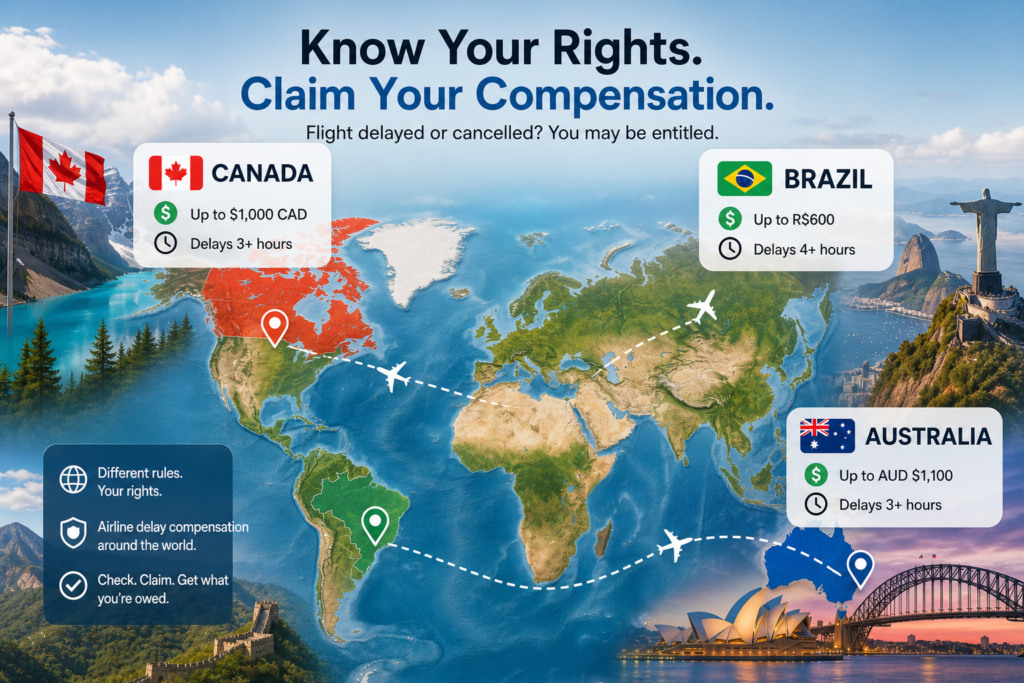
Passenger rights vary globally but are strengthening:
- Canada (APPR): Strong protections with compensation up to CAD $1,000 for controllable delays or cancellations. Tiered payments apply (e.g., higher for longer delays), plus robust care obligations like meals and accommodation.
- Brazil & Others: ANAC Resolution 400 provides compensation and assistance; enforcement can vary but often favors passengers.
- Australia: Relies on Australian Consumer Law for guarantees of services. While not as standardized as EU261, passengers can seek refunds or compensation for significant disruptions through airlines or courts.
Step-by-Step – How to Claim Compensation
Follow these steps to maximize success:
- Document everything — Keep your boarding pass, delay notifications, photos of boards, and all receipts for meals/hotels.
- Contact the airline promptly — Use their app, website form, or airport desk while still at the airport.
- Submit a formal claim — Use official airline forms or third-party services like AirHelp (they take a fee but handle paperwork).
- Escalate if needed — Contact regulators: CAA (UK), national enforcement bodies (EU), or DOT (US).
- Respect time limits — Claims are often valid for 2–6 years depending on the country.
Practical Tips to Protect Yourself
Prevention and preparation are key:
- Buy comprehensive travel insurance with strong trip delay coverage.
- Choose credit cards offering automatic delay reimbursement for expenses.
- Book flexible or refundable tickets when traveling during peak seasons or bad weather.
- Arrive early, download airline apps, and use real-time flight trackers.
- Review your specific airline’s contract of carriage and delay policy before flying.
Common Myths
Myth: All delayed flights automatically qualify for cash compensation.
Reality: This is only true in regions with strong laws like the EU/UK/Canada and only for controllable disruptions.
Conclusion
Knowing your flight delay rights empowers you to travel confidently. Always document disruptions and claim what you’re owed. Regulations evolve, so verify with official sources for your specific journey. Safe travels!
FAQs:
What if my connecting flight is missed?
You’re usually protected for the entire journey if booked on one ticket. Airlines must rebook you and provide care.
Do extraordinary circumstances always exempt airlines?
Generally yes for compensation, but not always for basic care or refunds.
Can I claim for lost work time or vacation days?
Usually not directly, but proven additional expenses may be reimbursable under some rules (e.g., Montreal Convention).
What about codeshare flights?
Protection often follows the operating carrier or departure country rules.
How long does claiming take?
Airlines have set response times; regulators can enforce faster resolutions.
Is compensation per person or per booking?
It’s per passenger.
What if the airline offers vouchers instead of cash?
You can usually insist on cash where laws mandate it.
Are there new 2026 updates?
Always check official regulator sites, as rules continue to evolve toward stronger passenger protections.