
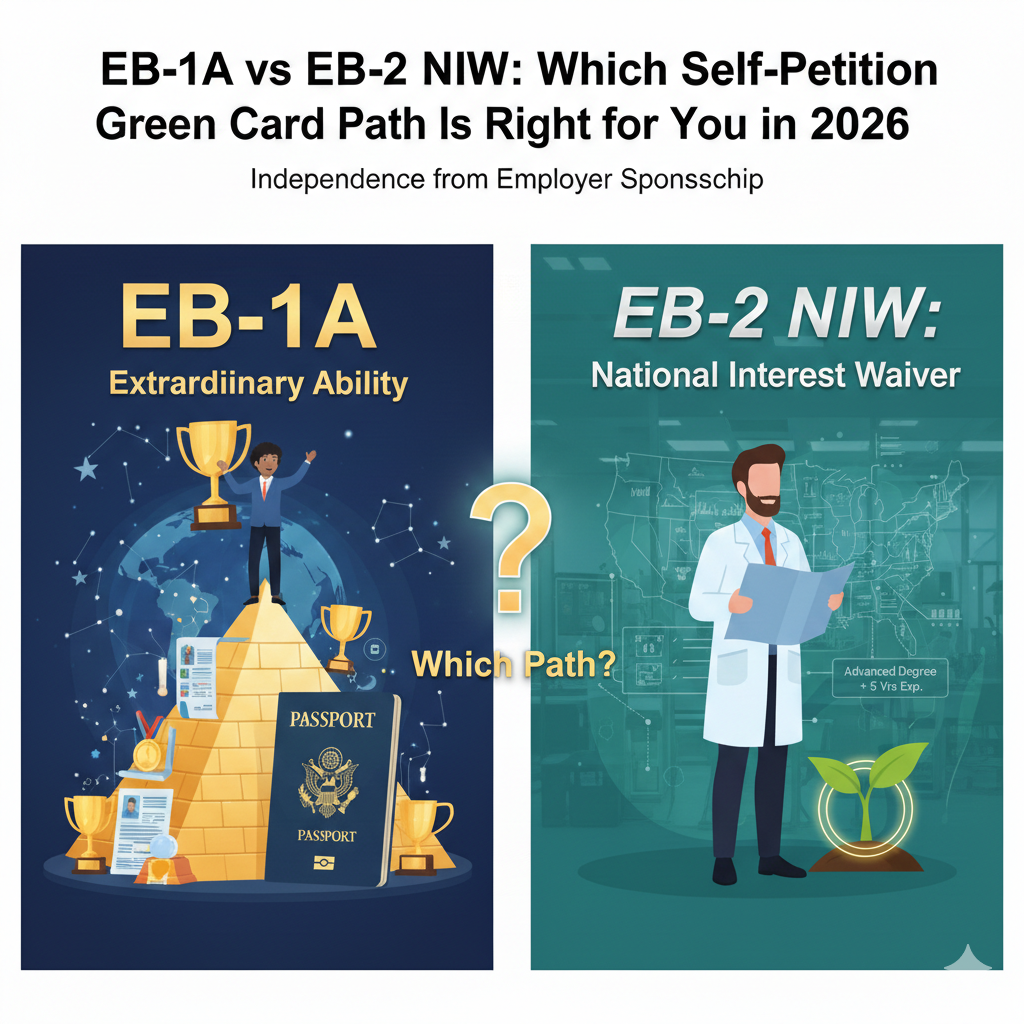
If you’re a talented professional seeking permanent residency in the United States, understanding the self-petition green card
process is your first step toward independence from employer sponsorship. Unlike traditional employment-based green cards that tie you to a specific employer, the EB-1A (Extraordinary Ability) and EB-2 NIW (National Interest Waiver) pathways give you complete control over your immigration journey, allowing you to change jobs freely, start your own business, or pursue research without relying on employer sponsorship. This guide will help you determine which self-petition pathway aligns best with your professional profile and career goals.
Understanding Self-Petition Pathways
Before diving into the comparison, it’s essential to understand what makes these categories unique. The EB-1A and EB-2 NIW processes represent a paradigm shift in U.S. immigration, allowing accomplished professionals to sponsor themselves based on their achievements and contributions rather than relying on an employer to petition on their behalf.
Both pathways eliminate the need for labor certification (PERM) and employer sponsorship, but they differ significantly in their requirements, processing times, and strategic approaches. Understanding these differences is crucial for selecting the pathway that maximizes your chances of approval while minimizing delays and complications.
EB-1A: The Extraordinary Ability Green Card
The EB-1A category is designed for individuals who have risen to the very top of their field, whether in sciences, arts, education, business, or athletics. The United States Citizenship and Immigration Services (USCIS) sets a high bar for this category, requiring applicants to demonstrate extraordinary ability through sustained national or international acclaim.
To qualify for an EB-1A petition, you must meet at least three of the following ten criteria:
- Awards and Prizes: Receipt of nationally or internationally recognized awards for excellence
- Membership: Membership in associations requiring outstanding achievement
- Published Material: Articles about you in professional or major trade publications
- Judging: Participation as a judge of others’ work in your field
- Original Contributions: Evidence of original scientific, scholarly, or business contributions of major significance
- Scholarly Articles: Authorship of scholarly articles in professional publications
- Exhibitions or Showcases: Display of your work at artistic exhibitions or showcases
- Leading Role: Performance in a leading or critical role for distinguished organizations
- High Salary: Evidence of high salary or remuneration compared to others in your field
- Commercial Success: Evidence of commercial success in the performing arts
The key to a successful EB-1A application is demonstrating not just that you meet three criteria, but that your achievements place you at the pinnacle of your profession. One of the most compelling advantages of EB-1A is the lack of visa retrogression for most countries, meaning faster processing times. Additionally, EB-1A applications are eligible for premium processing (15-day processing for an additional fee), and you don’t need a labor certification or job offer.
EB-2 NIW: The National Interest Waiver
The EB-2 NIW category is designed for professionals whose work benefits the United States’ national interest. This pathway is often more accessible than EB-1A while still offering complete independence from employer sponsorship. The NIW waives the typical requirement for labor certification and job offer if you can demonstrate that your work serves the national interest.
To qualify for EB-2 NIW, you must first meet the basic EB-2 requirements: either an advanced degree (Master’s or higher) or a Bachelor’s degree plus five years of progressive work experience in your field. Beyond these baseline qualifications, you must satisfy the three-pronged test established by the Matter of Dhanasar precedent decision.
First, your proposed endeavor must have substantial merit and national importance. This means your work should address significant challenges or opportunities in areas like technology, healthcare, renewable energy, education, or national security. Second, you must demonstrate that you are well-positioned to advance the proposed endeavor, showing through your credentials, experience, and track record that you have the ability to successfully execute your plans. Third, on balance, it would be beneficial to the United States to waive the job offer and labor certification requirements.
While EB-2 NIW doesn’t offer premium processing, it has become increasingly popular among STEM professionals, healthcare workers, researchers, and entrepreneurs. The approval standards are generally considered more flexible than EB-1A, making it accessible to a broader range of accomplished professionals. Applications in technology, healthcare, and renewable energy sectors have particularly strong approval trends, with success rates ranging from 65-85% when properly documented.
Key Differences Between EB-1A and EB-2 NIW
When comparing these two pathways, the evidence standards represent the most significant distinction. EB-1A requires demonstrating you’re at the very top of your field with extraordinary ability. The evidence bar is higher, emphasizing international recognition, major awards, and significant impact. In contrast, EB-2 NIW focuses on your proposed work’s national importance and your ability to advance it. While you need strong qualifications, the emphasis is less on being “extraordinary” and more on contributing valuable work to the U.S.
Education requirements also differ substantially between these categories. EB-1A has no formal education requirement; you can qualify based purely on achievements and recognition in your field, making it ideal for self-taught experts, artists, or entrepreneurs without advanced degrees. EB-2 NIW, however, requires an advanced degree or its equivalent (bachelor’s plus five years of progressive experience), which makes it more structured but potentially more straightforward for traditionally educated professionals.
Processing time considerations may influence your strategic decision. EB-1A offers premium processing (currently 15 business days) and typically has no visa backlog for most countries, allowing for faster green card receipt once approved. EB-2 NIW does not offer premium processing and may face longer backlogs, particularly for applicants from India and China due to per-country visa limitations.
Regarding approval difficulty, EB-1A is generally considered more challenging to obtain due to higher evidentiary standards, but it offers a faster path once approved. EB-2 NIW has more flexible standards, making it accessible to a wider range of professionals, though processing may take longer.
Which Path Should You Choose?
You should consider EB-1A if you have exceptional achievements with international or national recognition, have received major awards or prizes in your field, have extensive published material about your work, possess numerous citations or significant impact metrics, need the fastest possible processing time, or work in a field with clear markers of extraordinary achievement.
Alternatively, EB-2 NIW may be your optimal path if you have an advanced degree or equivalent experience, your work has clear applications benefiting U.S. national interests, you’re in fields like STEM, healthcare, renewable energy, or education, your achievements are strong but may not meet EB-1A’s “extraordinary” threshold, you’re willing to accept longer processing times for more flexible standards, or you have a clear proposal for future work in the United States.
Many professionals pursue dual filing strategies, submitting both EB-1A and EB-2 NIW applications simultaneously. This approach maximizes approval chances and can provide backup options. If one petition receives a Request for Evidence (RFE) or denial, you still have another pending application.
Conclusion
Choosing between EB-1A and EB-2 NIW is one of the most important strategic decisions in your immigration journey. Both pathways offer the invaluable benefit of self-petition, freeing you from employer dependence and giving you control over your permanent residency timeline. The right choice depends on your unique combination of achievements, credentials, and career goals.
EB-1A offers speed and prestige for those who can demonstrate truly extraordinary ability and international recognition. EB-2 NIW provides a more accessible route for accomplished professionals whose work clearly serves U.S. national interests. Some applicants benefit from pursuing both simultaneously, hedging their bets and maximizing approval chances.
Ultimately, success in either category requires thorough preparation, strategic evidence compilation, and a compelling narrative that frames your achievements within USCIS criteria. Whether you choose the extraordinary ability path, the national interest waiver, or both, the journey to self-petitioned permanent residency represents an achievable goal for talented professionals willing to invest in building a strong, well-documented case.