
As network infrastructures continue to evolve, organizations often face a familiar question: Is higher bandwidth always the answer, or does transmission distance matter just as much? While 100G and 400G technologies dominate industry headlines, 40G QSFP+ modules remain widely deployed in aggregation layers, metro networks, and campus backbones. In many real-world scenarios, the deciding factor is not peak throughput, but how far the signal must reliably travel without regeneration.
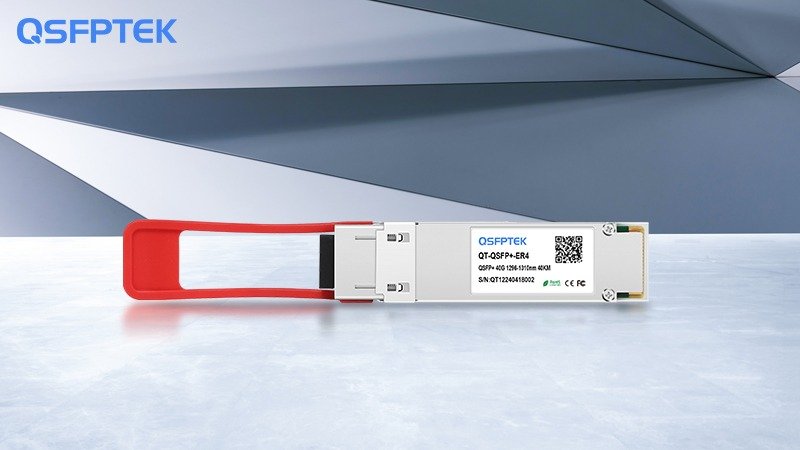
Among available 40G QSFP+ modules, the 40GBASE-ER4 QSFP+ 1310nm 40km Optical Transceiver Module stands out for its extended reach over single-mode fiber. A 40km transmission capability significantly expands deployment possibilities compared to standard 10km solutions. However, not every network requires this reach. Understanding when a 40km 40G optical module is truly necessary helps avoid overengineering while ensuring long-term network stability and scalability.
Understanding What 40km Really Means
Beyond Standard 10km Data Center Links
In typical data center environments, interconnections between switches rarely exceed a few hundred meters or a couple of kilometers. For these scenarios, short-reach or 10km long-reach modules are usually sufficient. A 40G 40km module, however, is designed for a very different operational context. It addresses environments where fiber spans extend across cities, industrial zones, or geographically dispersed facilities.
The 40km specification is not simply a marketing figure; it reflects a significantly larger optical power budget. Over single-mode fiber operating in the 1310nm window, attenuation accumulates steadily with distance. At approximately 0.4 dB per kilometer, a 40km span introduces substantial loss even before accounting for connectors, patch panels, and splices. A module capable of maintaining signal integrity over this distance must deliver higher transmit power, superior receiver sensitivity, and robust signal conditioning.
Campus Networks with Distributed Buildings
When Enterprise Infrastructure Exceeds 10km
Large enterprises, universities, hospitals, and research institutions often operate across multiple buildings spread over wide campuses. While some structures may be within a few kilometers of each other, others can be located significantly farther away. In such cases, a 10km module may not provide enough link margin to guarantee stable connectivity.
Deploying a 40km 40G optical module ensures that backbone links between distant buildings remain reliable even when additional losses from aging fiber or multiple connection points are considered. It also provides headroom for future reconfiguration without requiring immediate hardware replacement. For organizations planning long-term infrastructure investments, this additional reach can translate into operational flexibility and reduced upgrade frequency.
Metro and Regional Network Aggregation
Connecting Nodes Across a City
In metropolitan networks, service providers and large enterprises frequently need to aggregate traffic from distributed access points into centralized core facilities. These nodes may be separated by tens of kilometers. Although higher-speed options exist, many metro networks still operate efficiently at 40G in certain layers, particularly when cost control and equipment compatibility are priorities.
A 40km 40G optical module becomes relevant when linking aggregation switches located in different parts of a city. It enables direct point-to-point connections without intermediate amplification or regeneration equipment. Eliminating additional active devices reduces latency, simplifies management, and lowers maintenance complexity. For networks that do not yet require 100G capacity but demand extended reach, this solution provides a balanced compromise.
Data Center Interconnect Across Industrial Zones
When Facilities Are Geographically Separated
Not all data center interconnect scenarios occur within a single campus. In many industrial parks or regional business hubs, organizations operate multiple data centers several dozen kilometers apart. Regulatory requirements, disaster recovery planning, or power distribution constraints often dictate physical separation between facilities.
In these cases, a 40km 40G optical module can support stable data replication, backup synchronization, and service continuity between sites. While ultra-high bandwidth may not be mandatory for every workload, consistent long-distance transmission is critical. The 1310nm wavelength used in 40GBASE-ER4 technology offers relatively low dispersion and stable performance over single-mode fiber, making it well suited for these extended links.
Extending the Life of Existing 40G Infrastructure
Cost-Efficient Long-Distance Upgrades
Another scenario where a 40km 40G module becomes necessary is during incremental network upgrades. Many organizations have already invested heavily in 40G switching platforms. Transitioning immediately to 100G across all layers may not be financially practical or technically required.
If the main challenge is extending link distance rather than increasing bandwidth, upgrading to a 40km optical module can solve the problem without replacing core switching equipment. This approach preserves existing investments while addressing new connectivity demands. For networks with stable traffic growth but expanding geographic coverage, distance extension may deliver greater value than bandwidth expansion.
Optical Budget and Environmental Considerations
Accounting for Real-World Loss
The decision to deploy a 40km module should also consider environmental and operational factors. Fiber routes rarely follow perfectly straight lines, and real-world deployments often include multiple patch panels and splicing points. Each additional connection introduces insertion loss, gradually consuming link margin.
A 40km optical module typically offers a higher optical budget to compensate for such losses. In harsh industrial environments where temperature variations or aging infrastructure may affect performance, the additional margin can prevent intermittent link failures. Ensuring adequate link budget from the outset reduces troubleshooting complexity and supports consistent long-term reliability.
When 40km Is Not Necessary?
Avoiding Over-Specification
While extended reach provides flexibility, it is not always required. In tightly confined data center racks or short campus links, deploying a 40km module may increase cost without delivering tangible benefits. Higher-power optics can also consume slightly more energy, which may matter in high-density switch environments.
Selecting a 40km solution should therefore be driven by verified distance requirements, calculated link budgets, and realistic growth expectations. Over-specification can strain budgets and reduce overall network efficiency if distance capability remains unused.
Conclusion
Choosing a 40km 40G optical module is fundamentally about distance strategy rather than raw bandwidth ambition. When networks span large campuses, metropolitan areas, or geographically separated facilities, extended reach becomes a decisive factor in maintaining stable, direct connectivity. The 40GBASE-ER4 QSFP+ 1310nm 40km Optical Transceiver Module addresses these challenges by combining robust optical power, reliable single-mode transmission, and compatibility with existing 40G infrastructures.
Ultimately, you truly need a 40km 40G optical module when your network geography exceeds the limits of standard long-reach optics, and when link stability over extended distances outweighs the immediate need for higher throughput. By aligning optical reach with real deployment scenarios, organizations can build resilient, cost-effective networks that meet both present and future connectivity demands.