
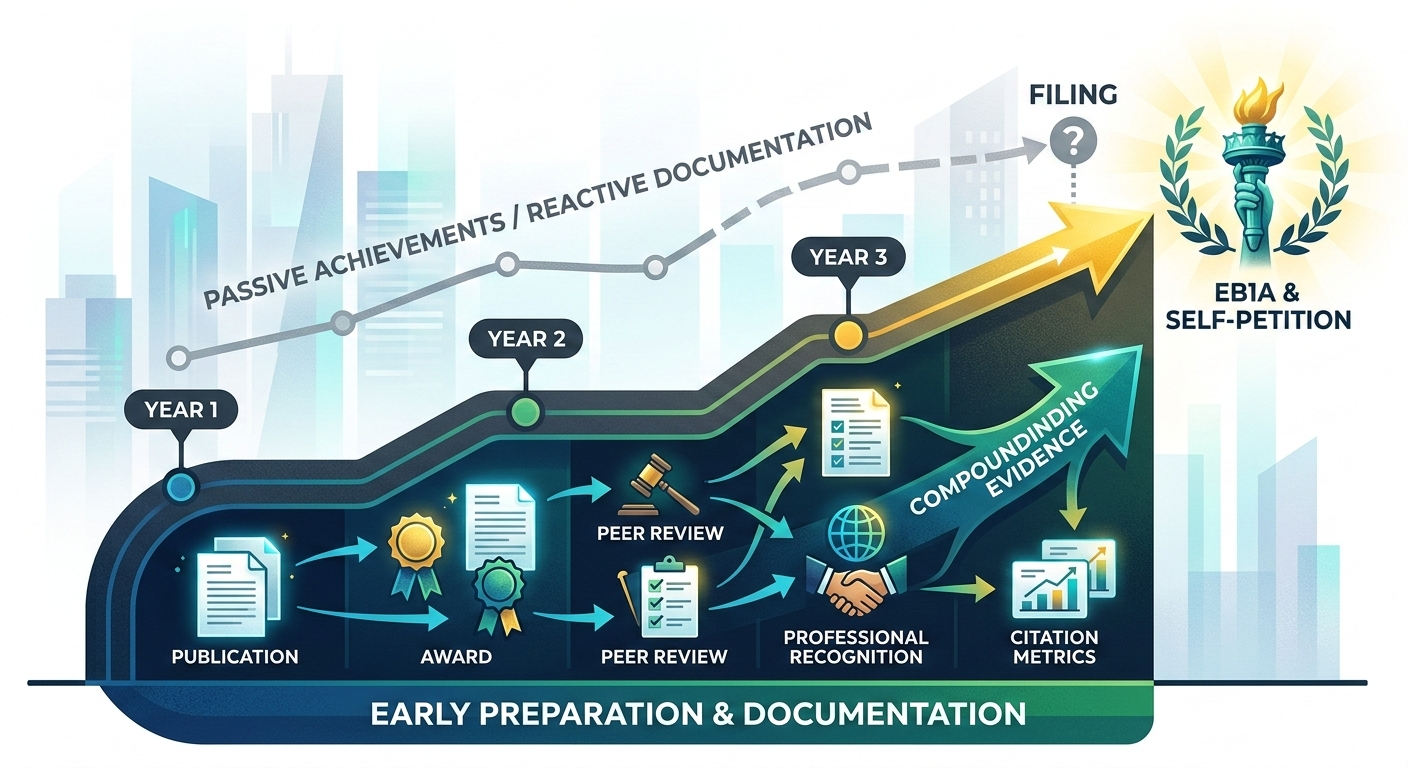
Most professionals start thinking about U.S. immigration when they feel ready. When their career has reached a certain point, when the timing feels right, when they have enough achievements to feel confident walking into the process. The problem with that instinct is that by the time it kicks in, months or even years of profile-building opportunity have already passed. The EB1A Visa is one of the most powerful immigration pathways available to skilled professionals but it rewards documentation, and documentation is something that has to be built over time. You cannot reconstruct the evidence trail that would have existed if you had been paying attention to it from the beginning. What you can do is start paying attention now, before the moments that matter most have already come and gone without being captured properly.
What Profile Building Actually Means
There is a version of immigration preparation that most professionals are familiar with — gathering CVs, collecting recommendation letters, compiling a list of publications a few weeks before an attorney asks for them. That is not profile building. That is reactive documentation, and it almost always produces a weaker record than the one that was available to be built.
Profile building is something different. It is the ongoing, deliberate practice of treating your professional achievements as immigration assets while they are happening not after the fact. It means understanding which types of recognition carry weight in immigration adjudication and positioning yourself to accumulate that recognition consistently over time. It means preserving the correspondence that proves an invitation was selective, not just accepting it and moving on. It means tracking where your work has been cited, discussed, or built upon by others in your field. None of this is complicated. But it requires a level of intentionality that most professionals never develop because nobody explained to them why it matters.
The Compounding Logic of Early Preparation
The reason early preparation matters so much is that immigration evidence compounds. A professional who has spent three years actively building their profile arrives at the point of filing with a fundamentally different record than one who spent the same three years achieving exactly the same things but never documented them strategically. The achievements might be identical. The evidence available to support a petition will not be.
This compounding effect works in both directions. Every year of thoughtful documentation makes the next filing stronger. But every year of passive achievement of letting recognitions pass by without capturing them, of publishing without tracking engagement, of presenting at conferences without preserving the invitations is a year that cannot be recovered. The window is always open going forward. It closes permanently going backward.
Where Most Professionals Start Too Late
The most common place professionals lose ground is in the early stages of their career, when they are genuinely producing impressive work but have not yet started thinking about immigration. A graduate student who publishes strong research, receives selective invitations to review manuscripts, wins departmental or national awards, and begins building a professional reputation is accumulating exactly the kind of record that immigration law rewards. They just do not know it yet. By the time they do know it, some of that evidence is gone the original invitation emails, the documentation that would have proved the award’s selectivity, the citation counts from when the paper first gained traction. Not all of it can be rebuilt.
This is why the conversation about immigration preparation ideally happens well before a professional is anywhere close to filing. The earlier it starts, the more runway exists to build a record that reflects genuine achievement accurately rather than one that approximates it imperfectly because the best supporting documentation is no longer retrievable.
The Difference Between a Strong Profile and a Weak One
Two professionals in the same field with equivalent career trajectories can arrive at the point of filing with dramatically different petition strength and the gap often has nothing to do with the quality of their actual work. It has to do with how their work was documented along the way. The professional with the stronger petition has a paper trail that makes their contributions legible to someone who was not there to witness them. Every claim is supported by specific, verifiable evidence. The peer review invitations are backed by correspondence that establishes the journal’s selectivity. The awards are accompanied by materials that show how competitive the field was. The citations are tracked and presented in a way that demonstrates genuine influence rather than incidental reference.
The professional with the weaker petition has equivalent achievements but a record that requires inference, approximation, and trust in assertions that cannot be independently verified. In an environment where adjudicators review thousands of petitions and approach each one with trained skepticism, that difference in documentation quality produces materially different outcomes.
Building Toward the Self Petition Green Card Standard
The Self Petition Green Card standard is specific it asks for documented, verifiable evidence of achievement that places you among the top of your field. Meeting that standard is entirely possible for a wide range of skilled professionals. But meeting it well requires that the evidence exists in a form that can actually be presented. A reputation that everyone in your field acknowledges but that cannot be documented is not a petition. An achievement that genuinely places you among the best in your area but was never captured in a way that an adjudicator can verify is an opportunity that has been left on the table.
The professionals who navigate this process most successfully are the ones who understood early that their career achievements and their immigration profile were the same thing. Every selective invitation accepted and documented, every piece of recognition captured with the right supporting materials, every contribution tracked and preserved all of it is both a professional milestone and an immigration asset. Treating it as both from the beginning is the single most practical thing any skilled professional can do to strengthen their eventual petition.
Conclusion
The professionals who navigate U.S. immigration most successfully are almost never the ones who scrambled at the last minute. They are the ones who understood early that their career achievements were also immigration assets and treated them accordingly. Every paper published, every award received, every invitation to speak or judge or review was documented, preserved, and positioned as part of a larger strategic picture. That kind of preparation cannot be replicated in the weeks before a filing deadline. It has to be built over time, with intention. If you are a skilled professional with serious ambitions in the United States, the most valuable thing you can do right now is not to file — it is to start building. The gap between where your profile is today and where it needs to be is almost always smaller than it feels, but only if you start closing it now rather than later. For anyone still weighing their options and trying to understand which pathway makes the most sense for their background, this guide is a useful place to begin.