

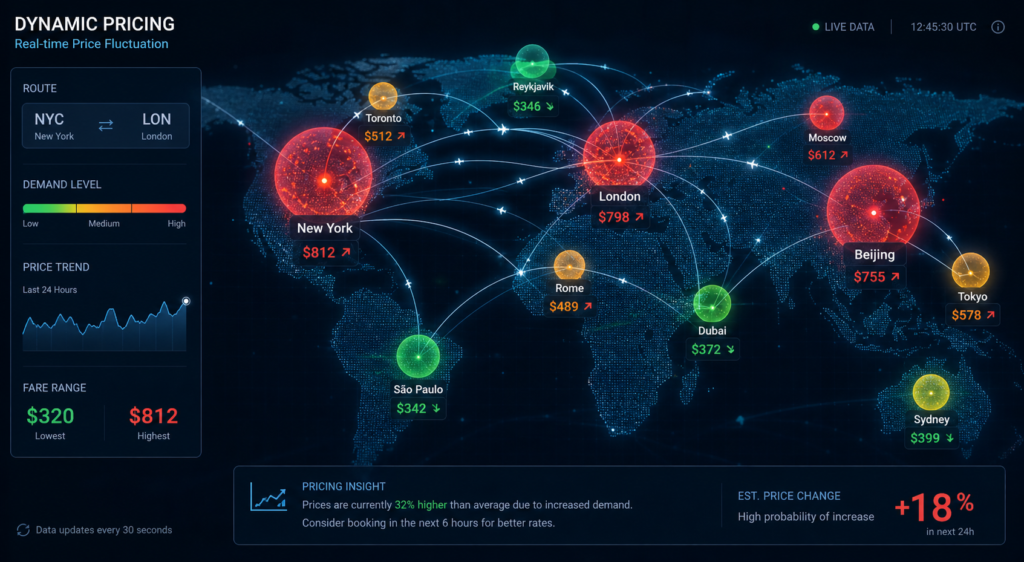
You refresh the page and the price jumps $150 in an hour. One minute a round-trip from New York to London looks like a bargain, and the next it costs a fortune.
This is the reality of airline revenue management — the sophisticated system airlines use to set prices in real time. In this insider guide, you’ll learn exactly how airline revenue management works, why prices fluctuate so wildly, and how you can outsmart the system.
The History of Airline Revenue Management
Before 1978, U.S. airline prices were strictly regulated. The Airline Deregulation Act of 1978 changed everything, allowing carriers to set their own fares and routes.
The modern era of airline revenue management began in the early 1980s when American Airlines developed one of the first automated yield management systems to compete with low-cost carrier PeopleExpress. The strategy was so successful that PeopleExpress eventually went out of business.
Today, airline revenue management has evolved into highly advanced AI-powered systems that adjust prices thousands of times per day.
What Is Airline Revenue Management?

Airline revenue management is the art and science of predicting consumer behavior and optimizing price and availability to maximize revenue from every flight.
The core principle is simple:
Sell the right seat, to the right customer, at the right time, for the right price.
Airlines treat every seat as a perishable product — once the plane departs, an empty seat is lost revenue forever.
How Airlines Segment Customers
The foundation of airline revenue management is customer segmentation. Not all passengers are willing to pay the same price:
- Business travelers → book late, need flexibility, pay higher fares
- Leisure travelers → book early, price-sensitive, flexible dates
Airlines use fare classes (Y, J, C for business; M, Q, V, etc. for economy) with different restrictions (advance purchase, minimum stay, change fees) to prevent high-paying customers from buying cheap tickets.
The Revenue Management Toolkit
1. Demand Forecasting Revenue teams use historical data, seasonality, events, economic indicators, and machine learning to predict demand months in advance.
2. Inventory Control Airlines open and close fare buckets in real time. Strong demand = fewer cheap seats.
3. Dynamic Pricing Modern systems move beyond traditional buckets to continuous pricing that can change by the minute.
4. Overbooking Airlines intentionally sell more tickets than seats (knowing 10-20% of passengers won’t show up).
5. Ancillary Revenue Bags, seat selection, and priority boarding have become huge profit drivers, especially for low-cost carriers.
Psychological Tactics Used in Airline Revenue Management
- Price anchoring (showing higher “original” prices)
- Scarcity messages (“Only 3 seats left at this price”)
- Tiered bundling (Basic / Standard / Flex)
- Personalized pricing based on loyalty data and browsing behavior
How to Beat Airline Revenue Management (Pro Traveler Tips)
- Book on Tuesdays or Wednesdays when possible
- Use flexible date search tools
- Set price alerts on Google Flights and Kayak
- Master award travel with miles and points
- Consider nearby airports
- Watch for error fares
The Future of Airline Revenue Management

AI and the New Distribution Capability (NDC) are enabling hyper-personalized offers. Sustainability may soon bring carbon-based pricing and “green premiums.”
FAQ Section
Why do flight prices change so often?
Airline revenue management systems continuously adjust prices based on real-time demand, competitor pricing, and remaining seats.
Do airlines overbook on purpose?
Yes. Sophisticated statistical models predict no-shows and overbook accordingly.
What is the best way to find cheap flights?
Be flexible with dates, use price alerts, combine points with cash, and understand basic airline revenue management principles.